Duane West
In Cold BloodDuane West is the Finney County attorney who announced that the prosecution would seek the death penalty against Dick and Perry Smith. His role is defined by a public argument about punishment and public safety: he treated the violence of the Clutter murders and the possibility of parole under a life sentence as reasons that a death sentence was necessary.
Office and Public Profile
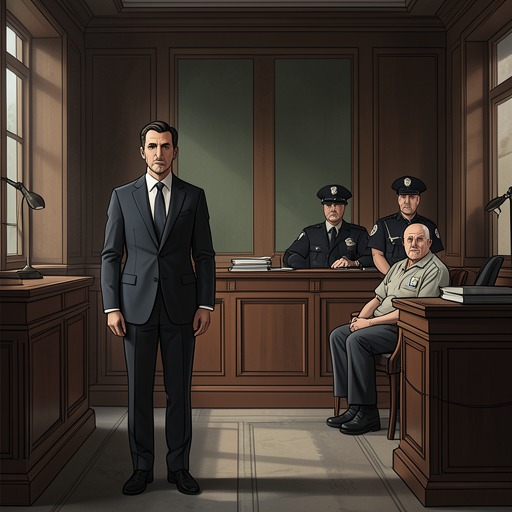
West was twenty-eight, portly, and described as ambitious; although he looked forty, and sometimes fifty, he was still a young county attorney. The narrative introduces him not through a private scene but through his official decision, delivered to news reporters as the case moved toward trial. His public position made him a central voice in the prosecution’s account of what justice required.
The Decision to Seek Death
West said that if the case went before a jury, he would ask jurors to impose the death penalty if they found the defendants guilty. If Dick and Perry Smith waived a jury trial and pleaded guilty before a judge, he would ask the judge to set the same penalty. The request, therefore, was not conditional on one particular route to conviction: West stated that the prosecution would seek death under either of the two outcomes he described.
He presented the decision as considered rather than automatic, explaining that he had not arrived at it lightly. His stated grounds were the crime’s violence and the apparent absence of mercy toward its victims. He framed the proposed sentence as a means of protecting the public, not simply as an expression of outrage at the killings.
Kansas Law as His Rationale
West also relied on the state’s sentencing framework. He said Kansas had no sentence of life imprisonment without the possibility of parole, and that people sentenced to life served, on average, fewer than fifteen years. In his argument, the practical effect of a life sentence mattered: it would not ensure that the defendants remained imprisoned for life. The projected early release supplied the connection between his stated concern for public safety and his demand for capital punishment.
That reasoning is presented as West’s public case for the penalty, not as a judicial finding about the defendants’ eventual sentences or the merits of capital punishment. His announcement set the prosecution’s objective before the jury proceedings began and made the state’s sentencing position explicit.
Presence at the Trial
On the first morning of court, West appeared in a new suit, as did the other lawyers. His new shoes creaked and squealed as he walked, a small physical detail that places the prosecutor amid the ceremony and self-consciousness surrounding the trial’s opening. The courtroom was a modest third-floor chamber in the Finney County Courthouse, and the jury-selection process concluded within four hours, drawing the fourteen men, including alternates, from the first forty-four candidates.
The account gives West no extended personal history or private reflections. Instead, it defines him through the institutional weight of his announcement and the visible formality of his courtroom role: a young county attorney who committed the prosecution to seeking death, and who entered a trial in which that demand would stand alongside the evidence and the jury’s judgment.